
High Performance at What Cost? Rethinking Productivity, Systems, and Leadership

What if your team is delivering results, but the way they're achieving them isn't sustainable?
We're constantly hearing that leaders need to do more with less. More productivity, more efficiency, better performance. And with new technologies making it possible to work faster and access more information than ever, expectations continue to grow.
But I think there's an important question we don't ask often enough: Are we actually improving performance, or are we simply asking people to do more?
This was at the heart of our October #PeopleBeforeStrategy Roundtable, where I was joined by two incredible guest experts: Yéwándé Faloyin, the Founder, OTITỌ Leadership & People Development specializing in leadership and performance, and Anu Ishola DrPH MPH, the Executive Director of the Women's Impact Alliance.
What I appreciated about this conversation was how our guests challenged assumptions that many of us take for granted. We explored everything from how we define performance to the systems we build, the unintended consequences of accountability, and the leadership practices that help people thrive.
We also started with a question I think more leaders could benefit from asking themselves: When was the last time you stopped doing something and realized nothing important was lost?
I shared an example from my own work. For a long time, I had been hosting workshops as part of an initiative that matters deeply to me. I continued making space for them on my calendar, preparing materials, and showing up because I believed it was something I needed to do. But over time, fewer people were attending, and sometimes nobody showed up at all.
Eventually, I decided to stop hosting them in the same way. And what surprised me was that nothing significant was lost. Instead, I was able to reimagine how I contributed to that initiative in a way that better reflected people's actual interests and needs.
It reminded me that just because something has been part of our routine doesn't mean it continues to create value. Sometimes we're so focused on what else we need to do that we forget to question what we could stop doing.
That reflection set the stage for a conversation about what meaningful, sustainable performance really requires.
1. Defining Performance: More Doesn't Always Mean Better
Are we measuring performance, or simply measuring activity?
Yolanda challenged us to rethink the familiar expectation that leaders and teams should constantly do more with less. As she put it:
"the question assumes that doing more equals more innovation, better efficiency, better performance, and it doesn't, right?"
She explained that we often use words like productivity, efficiency, and performance interchangeably without clearly defining what they mean. Her analogy was particularly useful: high performance for someone lifting weights isn't the same as high performance for a runner or someone practicing yoga. So why would we assume high performance should look the same across different roles, teams, or organizations?
Performance needs to be defined in relation to what we're actually trying to achieve. This resonated with me because I've always questioned how we talk about productivity. Sometimes completing one meaningful task is more valuable than checking ten things off a list. And sometimes doing less creates the space to do better work.
Anu added another important perspective. Drawing on her experience inheriting and building teams, she described how organizations can appear successful because a handful of exceptional people are carrying most of the workload.
As she shared:
"we build systems not around processes, not around things that would sustain it, but around having key superstars that are overworking"
The results might look impressive, but what happens when those people leave, need time off, or burn out? Anu challenged us to consider whether organizations are building sustainable processes or simply depending on individuals to keep everything running.
That distinction matters because a team can be producing impressive results without operating in a way that supports long-term performance.
When you describe your team as high-performing, what are you actually measuring? Is it the volume of work, the quality of outcomes, the ability to adapt, or the capacity to consistently deliver results without depending on extraordinary individual effort?
Perhaps we need to get clearer about what success looks like before asking people to achieve more of it.
2. Sustainable Systems: Are We Supporting Performance or Creating Interference?
One of my favorite moments from the conversation was when Yewande shared a simple performance formula:
Performance = Potential − Interference
We spend a lot of time thinking about how to increase people's potential. We invest in training, develop skills, hire talented people, and encourage them to become more effective. But how much attention do we give to the things getting in their way?
Yewande explained that interference can take many forms. It might be inadequate equipment, unreliable internet, unclear expectations, or an environment that doesn't support people in doing their best work. Sometimes the interference comes from the very systems we've created to improve performance.
Her point was that developing individuals is only part of the equation. We also need to create environments that allow people to use their capabilities effectively.
Anu brought this to life through her experience working in international development. She described a project in Liberia where community health workers were using mobile phones to support learning and collect data. The goal was to improve efficiency and accountability, but there was a challenge: different funding partners required different reporting systems.
That meant community health workers were completing multiple forms for different stakeholders alongside using the digital tool. All in the name of accountability, yet these requirements were making it harder for people to do the work they were actually there to do.
Anu highlighted the need for greater collaboration among funders, implementing organizations, and other stakeholders. Her example made me think about how often we introduce additional processes without fully considering their impact.
Another reporting requirement, meeting, approval process, or platform might make sense individually. But collectively, are these additions helping people perform, or are they simply creating more work?
More systems don't automatically create better performance.
Anu also emphasized that sustainable systems need to work for the people within them, not just deliver external results. That includes documenting processes, sharing knowledge, conducting after-action reviews, and ensuring people can take time off without everything falling apart.
Yewande reinforced this distinction when she shared:
"a high performer or having a bunch of high performers is not the same as having a high performance system."
Sustainable performance requires ongoing attention. Systems need to evolve as circumstances change, and leaders need ways to regularly assess whether their processes are still supporting the outcomes they want to achieve.
This creates an opportunity for leaders to examine where interference exists within their organizations. Which processes genuinely support performance? What are we doing simply because we've always done it? Can our systems continue functioning when key people are unavailable? Are we creating an environment where people can perform well consistently?
Sometimes improving performance isn't about adding something. It's about identifying what we need to remove.
3. Leadership Practices: Culture, Communication, and Putting People First
Another important theme was the role leaders play in creating the conditions for sustainable performance.
Yewande made an observation that I think is especially relevant as organizations continue investing in new technologies and management tools:
"if your teams wouldn't do it without the system, they're probably not going to do it with the system."
We sometimes try to solve leadership and culture challenges by introducing another tool or process. A new performance management platform, a development planning template, or a reporting system might seem like the solution. But what happens when the underlying leadership behaviors aren't there?
If managers aren't having meaningful development conversations, introducing a development planning tool won't necessarily change that. If teams don't feel comfortable raising concerns, adding another feedback channel may not create openness.
The systems we introduce should support the culture we're trying to build, not substitute for it.
This also came through in our discussion about leading through uncertainty. An audience member had submitted a question about how transparent leaders should be with junior staff when significant changes are coming.
Anu shared how her organization has navigated uncertainty in the international development sector. Her approach emphasized honesty, clarity, and communicating next steps. Rather than withholding information or creating unnecessary panic, she described the importance of helping people understand what's happening and how the organization plans to respond.
Yewande added another important consideration:
"One, treating adults like adults."
She emphasized the importance of leaders being clear and confident in how they communicate, even when the message is difficult. She also encouraged leaders to communicate the broader vision behind decisions rather than relying solely on instructions.
This made me think about how easily leadership communication becomes focused on what people need to do rather than why it matters. We need you in the office. We need this report. We need to make these changes. But how often are we helping people understand the reasoning behind these expectations and how they connect to the organization's direction?
Anu's emphasis on building systems that support people also reminded us that leadership isn't just about achieving external results. It's about considering the experience of the people responsible for those results. As she explained during the conversation:
"your ‘productivity’ is directly tied to how satisfied you are at your job."
For me, this is where leadership becomes much more than managing tasks or monitoring performance. It's about creating conditions where people understand the direction, have the support they need, and feel able to contribute.
And that brings us back to the importance of putting people before strategy.
Final Words: Two Reminders for Leaders
As we closed the Roundtable, I invited both guest experts to leave us with one final thought. Their responses captured two ideas I hope more leaders will consider.
Yewande Faloyin: High Performance Requires Intention
Yolande reminded us that performance doesn't happen simply because we've hired talented people. Organizations need to be intentional about defining, developing, and supporting human performance, and that responsibility starts with leadership.
As she shared:
"If you personally are not high performance, no one else is going to be."
Her closing message was a reminder that leaders can't expect to create high-performance environments without examining their own behaviors and practices. High performance isn't something we can simply delegate to our teams. We have to participate in creating it.
Anu Ishola: Nothing About Us Without Us
Anu's closing reflection brought the conversation back to the people at the center of our organizations:
"nothing about us without us."
She explained that while this principle is often applied to policies and programs affecting communities, it's equally relevant within organizations.
There's often a gap between those developing strategy and those responsible for implementing it. But the people doing the work are often the ones who understand the challenges, inefficiencies, and opportunities most clearly.
If we want to build better systems, we need to involve the people who actually use them.
For me, this captures the essence of #PeopleBeforeStrategy. Not that strategy doesn't matter, but that the people responsible for making it happen need to be part of the conversation.
What Will You Do Differently?
I left this Roundtable thinking about how easily we can mistake activity for progress, exceptional individual effort for sustainable performance, and processes for effective leadership.
As a leadership and culture advisor, I work with leaders to become more intentional about how they lead themselves, their teams, and their organizations. That means creating space to reflect on the behaviors, expectations, and systems that influence how people work.
Because sustainable performance isn't just about what we achieve. It's also about how we achieve it and whether the people involved can continue to thrive.
So here's a question I'd love to leave you with:
What's one thing you could change about the way your team works that would improve performance without asking people to do more?
I would love to hear your thoughts.
Join Our Next #PeopleBeforeStrategy Roundtable
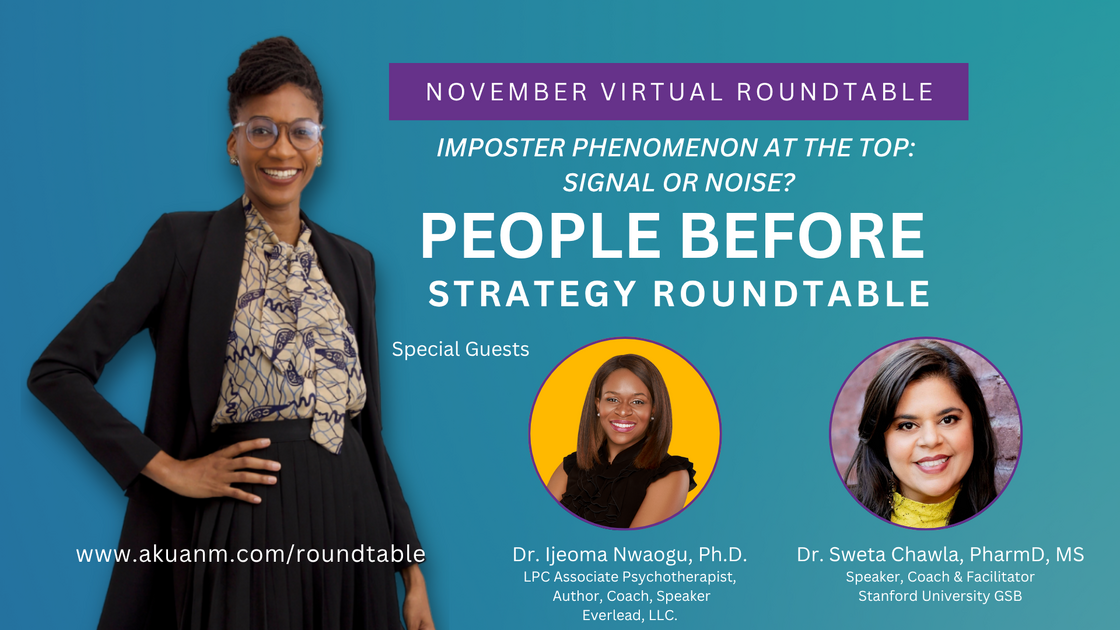
Imposter Phenomenon at the Top: Signal or Noise?
Even experienced leaders can struggle with self-doubt, perfectionism, and the pressure to constantly prove themselves. But what if those feelings are information rather than evidence of inadequacy?
On Thursday, November 19, 2026, from 5:30–6:30 PM GMT, I'll be joined by Ijeoma Nwaogu, Ph.D., CLC, NCC, LPC-Associate, author of Overcoming Imposter Anxiety, and Dr Sweta Chawla, Executive Coach and Creator of Leadership Beyond the Ladder®.
We'll explore how to distinguish useful signals for growth from unhelpful noise and strengthen your authentic leadership voice.
Join the next #PeopleBeforeStrategy Roundtable on Imposter Phenomenon at the Top: Signal or Noise? with Dr. Ijeoma Nwaogu and Dr. Sweta Chawla. DM me to reserve your spot and get more info.





Leaders aren't born; they're made.
This 5-minute assessment will help you understand what leadership stage you're currently in so you can determine your next steps.
© Copyright 2023, Akua Nyame-Mensah | Terms & Conditions | Website by Rachelle Deem
0 comments
Leave a comment