
Your Culture Isn't What You Say It Is

Big C, little c: Understanding culture as it's lived, not just designed.
You can have the best organizational values in the world, spend months developing your mission statement, and invest in leadership workshops, culture initiatives, and employee engagement surveys, but, none of that guarantees that people experience the culture you intended to create. Culture isn't just what we say. It's what we do, and more importantly, what people learn to expect from the way we do things.
During our September #PeopleBeforeStrategy Roundtable, I was joined by Dr. Anthony Moss-Zobel,PCC and André Philippe Lauer to explore the difference between the culture organizations design and the culture people actually experience. We discussed the unwritten expectations that shape behavior, the importance of curiosity when working across different cultures, and how feedback and role modeling help organizational values become part of everyday work. One idea kept coming up throughout our conversation:
Culture is already happening. The question is whether we're paying attention to it.
What do we mean by Big C and little c culture?
Big C culture represents the formal, visible elements of organizational culture. These include your mission, values, policies, and stated expectations. They are the things leaders intentionally design and communicate.
Little c culture is what happens in everyday interactions. It shows up in how people speak to one another, what happens when someone makes a mistake, who gets recognized, which behaviors are tolerated, and whether employees feel comfortable asking questions or challenging decisions.
Anthony introduced the metaphor of the cultural iceberg to illustrate this distinction. Above the surface are the things we can easily see. Beneath the surface are the expectations, habits, and interactions that shape people's experiences.
As he reminded us during the conversation, "People live by what they see."
This distinction matters because leaders can have the right intentions and still create environments where people learn to behave in ways that contradict those intentions.
So how do we close that gap?
Here are three insights from our conversation that I think every leader should consider.
1. Your values need to become observable behaviors
One of the questions I asked our guest experts was how a time-strapped founder or leader could begin examining their organization's culture.
Anthony's response brought us back to something practical: start with expectations. He introduced the concept of the psychological contract. Alongside the formal employment contract, people develop unwritten expectations about how the organization and its people should behave. These expectations influence how employees interpret everyday experiences, particularly when what they observe contradicts what they've been told.
Consider an organization that says innovation is one of its core values. Employees are encouraged to share ideas, but when someone suggests a different approach, their manager shuts them down.
What do they learn?
That innovation is valued, or that challenging the status quo might have negative consequences?
The answer isn't necessarily another workshop on innovation. It's examining what happens when someone actually demonstrates the behavior we're asking for.
Anthony also shared how he establishes expectations with his student teams. Before problems arise, he invites them to discuss what will happen if someone misses an assignment, doesn't respond, or needs additional support. Rather than assuming everyone has the same understanding of commitment, the group develops shared expectations about what commitment looks like and how they will hold one another accountable.
I think there's an important lesson here for leaders.
We can't hold people accountable for expectations we've never made clear.
And we can't assume that because a value is written down, everyone understands how to demonstrate it.
This is especially important during onboarding, when new employees are learning not only what the organization says it values but also how people actually behave. The earlier we create opportunities to discuss expectations, the less we have to rely on people interpreting unwritten rules for themselves.
Put it into practice: Choose one of your organization's core values and ask your team what that value looks like in practice. Together, identify two or three observable behaviors that would demonstrate it, and discuss what should happen when those expectations aren't met.
2. Curiosity helps us distinguish differences from dysfunction
Another part of our conversation that resonated with me was André's perspective on working across different cultures and professional environments.
He reminded us that multicultural teams aren't simply made up of people from different countries. People also bring experiences from different organizations, industries, and working environments.
These experiences shape how they interpret expectations and how they demonstrate the values an organization wants to reinforce.
André shared an example about communication. He was raised in a culture that values direct communication. For him, being polite can mean getting to the point and saving someone time. Someone he was speaking with, who grew up in a Latin American country, had learned a different approach to politeness that placed greater emphasis on how a message was communicated.
Both were trying to achieve the same thing. They simply expressed it differently.
Now imagine those two approaches in the same organization.
A leader might interpret one as professional and the other as inefficient. But are they actually working toward different goals, or are they demonstrating the same value in different ways?
This is why André encouraged leaders to approach unexpected behavior with curiosity rather than immediately judging it. He suggested starting with an observation and asking questions such as:
"Can you tell me more about this?"
"Where did you pick up this way of doing things?"
"What are you trying to achieve with it?"
These questions create an opportunity to understand someone's reasoning before deciding whether their behavior needs to change.
They also create space for leaders to learn. Sometimes, the way someone else approaches a situation might reveal a different or more effective way of achieving the intended outcome.
A different approach isn't necessarily a cultural problem.
The important question is whether it supports or undermines what we're trying to achieve together.
This is particularly relevant for leaders managing diverse teams, where different communication styles, working preferences, and professional experiences can easily be mistaken for a lack of alignment. Curiosity doesn't mean avoiding difficult conversations or accepting every behavior. It means taking the time to understand what is happening before deciding how to respond.
Put it into practice: The next time someone approaches a task differently than you expected, ask about their intention before offering a correction. Consider whether the behavior genuinely conflicts with your team's goals or simply reflects a different way of achieving them.
3. Culture change needs feedback, repetition, and role modeling
Toward the end of our conversation, I asked both experts how leaders can make culture change stick.
Because identifying a gap between stated values and lived culture is one thing. Actually changing the way people behave is another.
Anthony emphasized repetition, meaning, and feedback. He reminded us that sustainable learning and behavior change require opportunities to practice, reflect, and adjust over time.
He also shared an approach he calls "flip feedback."
Instead of beginning a feedback conversation by telling someone what they need to improve, he invites them to reflect first.
He might ask:
"What's been going well?"
"What are you proud of?"
"What are you surprised by that went well?"
"What would you change or modify?"
"What has worked for you before that you could bring into this situation?"
I particularly appreciated these questions because they shift the conversation from simply identifying what's wrong to helping people recognize what they already know and what they can do differently. Rather than only receiving instructions, employees have an opportunity to participate in their own learning and connect the change to something meaningful.
This doesn't mean avoiding difficult feedback or ignoring missed expectations. It means creating an environment where people can engage with feedback constructively rather than immediately becoming defensive.
André reinforced the importance of creating the right environment for feedback. He also challenged leaders to examine their own behavior. Are we demonstrating the culture we're asking others to create? Are we recognizing people when they demonstrate our values? Are we involving employees in shaping the culture, or simply communicating decisions made by senior leadership?
One example André shared involved employee engagement surveys.
Some employees were hesitant to share their experiences because they didn't trust how their responses would be used. The organization had described the surveys as anonymous when confidential was the more accurate term.
That distinction mattered.
Without clarity, employees questioned whether they could safely share their experiences. And without honest feedback, leaders had a less useful picture of what was actually happening.
This example reminded me that culture is shaped not only by our intentions but also by the systems we create and the way people experience those systems.
If we say we value openness but don't explain how feedback will be used, we shouldn't be surprised when people hesitate to share.
If we say we value collaboration but only recognize individual performance, we may be reinforcing the opposite behavior.
And if we say we value learning but respond negatively when someone makes a mistake, people may become less willing to experiment.
What leaders do repeatedly teaches people what matters. What organizations reward, recognize, and tolerate reinforces those lessons.
This is why culture change cannot rely exclusively on communication campaigns or annual surveys. It needs to be reinforced through the systems and relationships people experience every day.
Put it into practice: Look at one existing leadership routine, such as a team meeting, one-on-one, or performance conversation. Identify one way you could use it to reinforce the culture you want to create. Focus on a small behavior you can repeat consistently rather than launching another initiative.
Culture isn't separate from performance
As a Leadership & Culture Advisor, much of my work involves helping leaders create clarity about their priorities, expectations, how they want to lead, and what their teams need to succeed.
Our September conversation reinforced why this work matters.
We can have the best strategy in the world, but if the people responsible for bringing that strategy to life don't understand what's expected, don't feel comfortable sharing feedback, or experience behaviors that contradict the organization's values, execution becomes much more difficult.
Culture isn't an additional project that leaders need to find time for. It's already present in the way work gets done.
The opportunity is to become more intentional about it by observing what's happening, asking better questions, making expectations clearer, and creating environments where people can learn, contribute, and perform.
I want to leave you with the questions both Anthony and André shared toward the end of our Roundtable.
Anthony encouraged us to remain curious, notice the behaviors happening around us, and ask whether they reflect the culture we're trying to create.
André offered three questions that I think are particularly useful for leaders who want to examine the gap between their intentions and their organization's everyday reality:
1. Am I role modeling the culture I want to see?
Don't rely solely on your own impression. What does the feedback you receive, and what people say when you're not in the room, suggest about how you're showing up?
2. Is what I'm observing an adaptation or a dysfunction?
Is someone demonstrating our values in a different way, or is their behavior working against what we're trying to achieve together?
3. What are our existing systems incentivizing people to do?
Are our processes, recognition, and promotion decisions reinforcing the behaviors we want, or are we unintentionally rewarding something else?
These are questions worth revisiting regularly, especially when organizations are navigating change, limited resources, and increasing expectations.
Because the next step isn't simply designing a better culture.
It's designing systems that make the culture we want easier to live.
And that's exactly what we'll be exploring next.
Join us for our October Roundtable
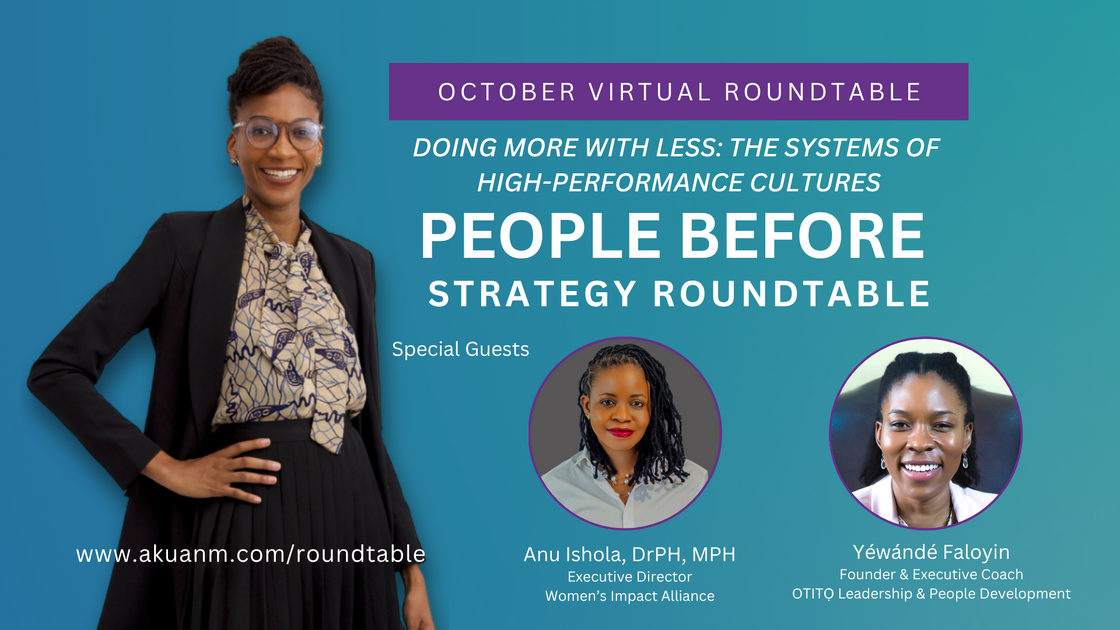
Doing More With Less: The Systems of High-Performance Cultures
Economic constraints and transformation fatigue have become constants for many leaders. Yet the pressure to deliver results, develop people, and sustain performance continues. Sustainable high performance doesn't come from continually asking people to push harder. It requires examining how we organize work, develop people, and align culture with performance. Building on our September conversation, we'll explore what it takes to create the systems and conditions that help people do their best work, even when resources are limited.
I'll be joined by two guest experts:
Yéwándé Faloyin - Executive Leadership Coach; Founder & CEO,
Anu Ishola DrPH MPH - Executive Director, Women Impact Alliance
Together, we'll explore how leaders can sustain excellence while navigating limited resources and increasing demands, without making individual effort the solution to every organizational challenge.





Leaders aren't born; they're made.
This 5-minute assessment will help you understand what leadership stage you're currently in so you can determine your next steps.
© Copyright 2023, Akua Nyame-Mensah | Terms & Conditions | Website by Rachelle Deem
0 comments
Leave a comment