
Beyond Town Halls: Communicating in Ways That Build Trust

Communication has never been easier.
Leaders can send a message to thousands of employees in seconds. We have town halls, Slack channels, Teams meetings, AI-powered summaries, video updates, and company-wide emails. Yet despite having more ways to communicate than ever before, many employees still say they don't understand why decisions are being made or where their organization is heading.
During July's #PeopleBeforeStrategy Roundtable, guest experts Eloïse Eonnet and Nana Amoako-Anin challenged us to rethink what effective communication really looks like. Their conversation reminded us that communication is not simply about sharing information. It's about building trust, creating understanding, and helping people make sense of change.
As organizations continue to navigate evolving ways of working, these are not "nice-to-have" leadership skills. They are foundational to leading people through uncertainty and transformation.
Great Leaders Communicate the Relevant Context
One of the most thought-provoking moments of the discussion came when Eloise observed, "We often confuse sharing information with actually communicating."
Many leaders assume that once an announcement has been made, communication is complete. In reality, that is often where communication begins.
People rarely need every detail behind a decision. They do, however, need enough information to understand why the decision was made, how it connects to the organization's direction, and what it means for them in their role. Effective leaders recognize that communication is not about sharing everything; it is about sharing what is most relevant to the audience in front of them.
As Eloise explained, leaders create trust when they bring people into their thinking. That doesn't mean opening every strategic discussion or revealing every consideration behind a decision. It means helping people understand the challenge or risks that needed to be solved, the factors that influenced the decision, and the role they play in what comes next.
When leaders communicate the relevant context, people are less likely to fill in the gaps with assumptions. Instead, they are better equipped to understand the direction of travel and contribute with confidence.
Change Is Emotional Before It's Operational
Organizational change is often communicated as though it is purely operational.
A new strategy is introduced.
A process changes.
A restructuring is announced.
A new technology is implemented.
Yet the experience of change is rarely operational for the people living through it. It is emotional.
People naturally wonder what the change means for their work, their relationships, their future, and their ability to succeed. If leaders focus only on explaining what is changing without acknowledging how change is experienced, they risk creating distance rather than trust.
Nana reminded us that leadership communication should be human, not simply persuasive. At the same time, she challenged the growing culture of what she described as "hyper-storytelling." In an age where leaders are often encouraged to share increasingly personal stories, it can be easy to assume that authenticity requires complete openness.
It doesn't.
Authenticity is not about making yourself the center of every message. Nor is it about sharing more simply because vulnerability is seen as a leadership strength. Rather, it is about recognizing the emotional reality of change, communicating honestly about what is known and unknown, and responding with empathy that is appropriate for the moment and the audience.
People are not looking for leaders who have every answer. They are looking for leaders who acknowledge uncertainty without amplifying it, demonstrate care without creating dependency, and communicate with honesty while maintaining confidence in the path forward.
Trust Is Built Before You Need It
Perhaps the most important reminder from the conversation was that trust is rarely built during the moments that test it.
It is built in the conversations that come long before.
Trust develops every time a leader follows up after a difficult discussion. It grows when leaders explain the reasoning behind a decision instead of simply announcing it. It strengthens when people feel informed, listened to, and respected, even if they disagree with the outcome.
No leader communicates perfectly every time. Every leader will eventually have a conversation that doesn't land as intended, a message that is misunderstood, or a decision that is questioned.
The goal is not perfection.
The goal is to build a foundation of trust over time so that when those inevitable moments occur, people are more likely to ask questions instead of making assumptions, extend grace instead of withdrawing trust, and continue moving forward together.
Communication is not measured by how often we speak. It is measured by how consistently we help people understand, engage, and feel confident in the direction ahead.
As leaders prepare for the future of work, this may be one of the most important habits they can develop. The organizations that thrive will not necessarily be those with the most sophisticated communication tools. They will be the ones whose leaders consistently build trust through thoughtful, relevant, and human communication.
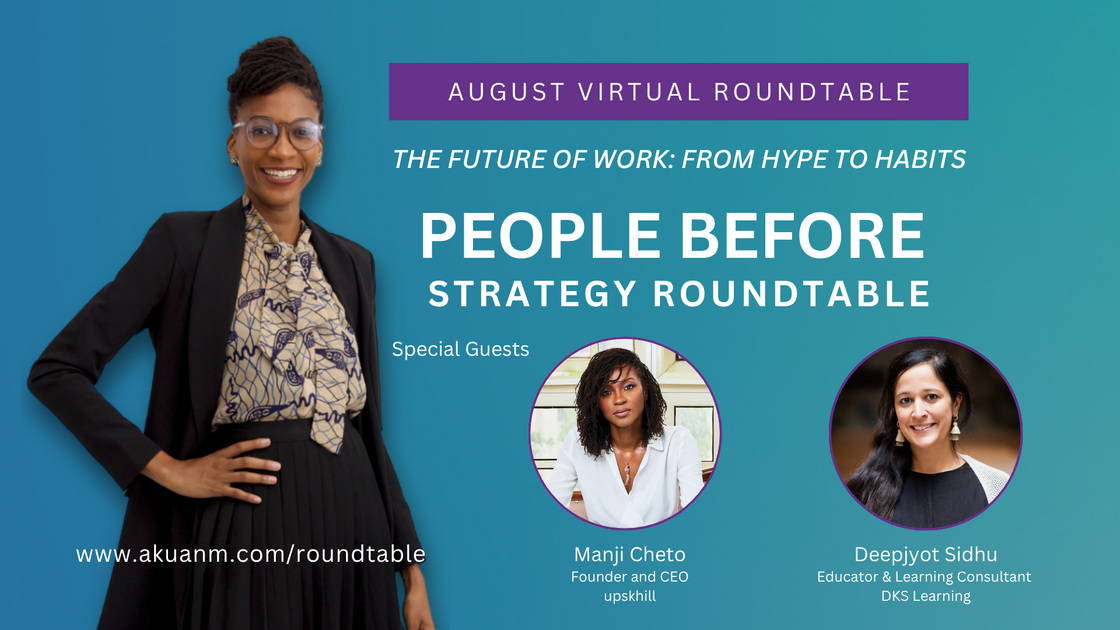
Join the next #PeopleBeforeStrategy Roundtable, The Future of Work: From Hype to Habits, with Deepjyot Sidhu and Manji Cheto. Together, we'll explore how leaders can move beyond trends and build practical habits that make hybrid work, AI adoption, and flexible work both strategic and people-centered. Click here to register.





Leaders aren't born; they're made.
This 5-minute assessment will help you understand what leadership stage you're currently in so you can determine your next steps.
© Copyright 2023, Akua Nyame-Mensah | Terms & Conditions | Website by Rachelle Deem
0 comments
Leave a comment